

Everything you need to know about visiting Cornwall
Cornwall has a way of making the rest of England feel a long way off, and that’s entirely the point. Cut off almost completely by the sea on three sides, this is a county with its own language, its own flag, and a coastline so varied that the beach you swim at in the morning can feel like a different country to the one you walk along at sunset.
Turquoise water and white sand on the north coast give way to sheltered fishing harbours and subtropical gardens on the south, while the far west, out past Land’s End, feels genuinely remote, closer in spirit to the mid-Atlantic than to London. Add in some of the best surfing in Britain, a food scene that punches well above its weight, and a coastal path that runs the entire way round, and it’s easy to see why Cornwall keeps drawing people back year after year.
A log cabin here suits a holiday built around the outdoors, whatever form that takes: an early surf session, a coastal walk with a pasty at the end of it, or simply a long, unhurried evening watching the light change over the water. Cornish evenings, particularly in summer, have a habit of stretching out far longer than planned.
What follows covers the north and south coasts, the far west, and Cornwall’s food and gardens, everything you need to plan a proper Cornish break.
Why Stay in Cornwall
scenery
Over 400 miles of coastline, subtropical gardens, dramatic cliffs, and some of the finest beaches in Britain.
activities
Surfing, coastal walking, sailing, and exploring fishing villages that have barely changed in a century.
access
The A30 runs the length of the county, with the Great Western Railway's Night Riviera sleeper connecting London directly to Penzance.
romance
A sunset at Land's End and dinner in a harbourside restaurant have made this one of Britain's most enduring romantic getaways.
The North Coast
Newquay is Cornwall’s surfing capital, its beaches, particularly Fistral, drawing surfers of every ability from complete beginners taking their first lesson to serious competitors chasing genuinely world class waves. The town itself has a lively, slightly boisterous energy that suits anyone wanting their Cornish holiday with a bit more buzz to it.
Further along, Bedruthan Steps offers something altogether quieter and more dramatic, its huge rock stacks rising straight out of the sand, best viewed from the clifftop path above rather than the beach itself, since the tide comes in fast and the currents here are genuinely dangerous for swimming. Watergate Bay, just north of Newquay, has become something of a food destination in its own right, thanks to Jamie Oliver’s Fifteen Cornwall restaurant sitting right on the beach.
Padstow, a little further round the coast, has built its entire modern identity around food, largely thanks to Rick Stein, whose various restaurants and shops now dominate a good stretch of the harbourside. The town’s small, picturesque harbour and the passenger ferry across to Rock make it an easy, pleasant place to spend an afternoon regardless of your interest in seafood.
St Ives and West Cornwall
St Ives has drawn artists for well over a century, and it’s not hard to see why once you’re standing on one of its beaches watching the particular quality of light that first brought painters here. The Tate St Ives gallery, overlooking Porthmeor Beach, and the Barbara Hepworth Museum and Sculpture Garden both make the most of that same connection between landscape and art.
The town’s narrow, cobbled streets, once home to a thriving pilchard fishing industry, are now lined with independent galleries, and the four separate beaches ringing the town mean there’s usually a sheltered spot to be found whatever the wind is doing that day.
St Michael’s Mount, a short drive south near Marazion, is one of Cornwall’s most photographed sights, a medieval castle and chapel perched on a tidal island reachable by a causeway at low tide or a small boat at high tide. The gardens here, tumbling down the rock in terraces, benefit from Cornwall’s mild climate in a way that would be impossible almost anywhere else in England.
The Lizard and Land's End
Land’s End marks the most westerly point of mainland England, and whatever you make of the commercial visitor centre built around it, the clifftop walk either side remains genuinely spectacular, with views out towards the Isles of Scilly on a clear day. Continuing south along the coast path towards Porthcurno brings you to the Minack Theatre, an open air amphitheatre carved directly into the cliffside, where watching a play with the Atlantic as a backdrop is unlike anywhere else in the country.
The Lizard Peninsula, Britain’s most southerly point, has a wilder, less visited character than the more famous headlands further north. Kynance Cove, with its turquoise water and dramatic serpentine rock formations, is regularly ranked among the most beautiful beaches in Britain, and is best visited outside peak midday hours in summer when the small car park fills quickly.
Mullion Cove and Cadgwith, both traditional fishing villages on the peninsula, have kept much of their working character, with lobster pots stacked along the harbour and boats still going out most days when the weather allows.
The South Coast and Fowey
Fowey sits on a steep hillside above a genuinely beautiful natural harbour, its narrow streets giving it a slightly Mediterranean feel that’s kept it popular with sailors and second-home owners for decades. Daphne du Maurier lived nearby for much of her life, and several of her novels drew directly on the surrounding coastline and countryside.
Charlestown, a short drive away, is a remarkably preserved Georgian china clay port, its harbour regularly used as a filming location thanks to how little it’s changed since the 18th century. Tall ships still occasionally moor here, adding to the sense of stepping back in time.
The Eden Project, housed in a series of vast geodesic domes built into a former china clay pit, is one of Cornwall’s most visited attractions, its Rainforest and Mediterranean biomes offering a genuinely immersive experience regardless of the weather outside, making it a reliable option whatever the forecast has planned for the day.
Top Experiences at a Glance
- Learn to surf at Fistral Beach, Newquay
- Watch the sunset from Land's End
- Visit St Michael's Mount at low tide
- Explore the Eden Project's biomes
- Walk the coast path to Kynance Cove
- Eat fresh seafood in Padstow
- See a play at the Minack Theatre
- Wander the galleries of St Ives
Food and Drink in Cornwall
The Cornish pasty remains the county’s most famous export, and locals have strong opinions about the correct crimp, the right filling, and precisely which bakery does it best. Cornwall’s fishing industry, still genuinely active in ports like Newlyn and Padstow, supplies restaurants across the county with catch landed the same day.
Padstow’s food scene, largely built around Rick Stein’s various restaurants, has helped establish Cornwall as a genuine culinary destination well beyond its traditional seaside reputation, and towns like Fowey and St Ives have followed with their own strong independent restaurant scenes.
Cornish cream teas come with their own regional rule, jam first, then cream, the reverse of the Devon method, and locals will happily explain why their way is correct. Cornwall’s cheese and dairy tradition runs deep too, with Cornish Yarg, wrapped in nettle leaves, among the best known.
The county’s drinks scene has grown considerably in recent years, with Cornish gin distilleries and a handful of vineyards taking advantage of the mild climate, alongside long-established local breweries like St Austell producing beer found in pubs across the county
Cornwall for Families and for Couples
Families are genuinely well catered for here. Rockpooling at low tide, surf lessons suitable for children from around eight upwards, and the Eden Project’s interactive exhibits all give plenty to do regardless of age. The National Maritime Museum in Falmouth and the various seal sanctuaries dotted along the coast add reliable rainy-day options too.
Couples tend to gravitate towards the quieter corners, a sunset walk at Land’s End, dinner in Fowey or Padstow, or an evening at the Minack Theatre if the timing works out. Cornwall’s whole atmosphere suits slower, more romantic pacing than its busier summer reputation might suggest.
For a rainy day, the Eden Project’s covered biomes and the various galleries in St Ives mean the weather rarely derails a Cornish holiday entirely, even in the changeable months either side of summer.
A Day Out From Your Cornwall Lodge
Start the morning at St Michael’s Mount, timing the crossing around the tide, then head to Land’s End for the afternoon, walking a stretch of the coast path towards Porthcurno before finishing at the Minack Theatre if a performance happens to line up with your visit.
For a gentler alternative, spend the morning in Padstow, browsing the harbour and having lunch, then head to Bedruthan Steps for a clifftop walk in the afternoon, finishing with dinner back at the cabin as the light fades over the sea.
Cornwall's Villages
Mousehole, pronounced “Mowzel” by locals, is one of Cornwall’s most picturesque fishing villages, its harbour lit with festive lights every Christmas in memory of a shipwreck disaster in 1981. Boscastle, on the north coast, sits in a dramatic natural harbour and has rebuilt itself carefully since a devastating flood in 2004. Polperro, further south, remains largely car free at its centre, its narrow streets and working harbour giving it a genuinely old-fashioned charm.
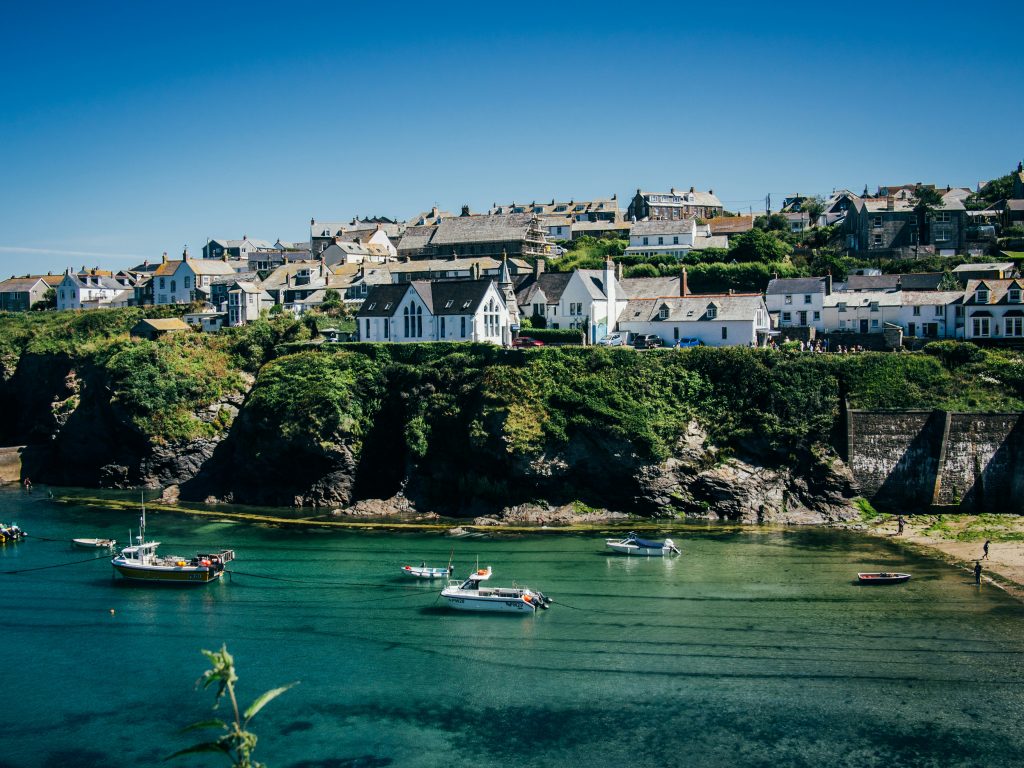
Port Isaac, familiar to many as the filming location for the television series Doctor Martin, retains its working fishing harbour and steep, narrow streets largely unchanged by its screen fame. Coverack, on the Lizard Peninsula, is smaller and quieter still, its thatched cottages and unspoiled beach making it a genuinely restful base for anyone wanting to avoid the busier north coast entirely.
What to Pack for Cornwall
A wetsuit or swimwear for the beaches, whatever the forecast, since the Atlantic stays cool even in high summer. Sturdy shoes for the coast path, which can be genuinely steep and uneven in places, and a windproof layer for the clifftops, where the wind rarely lets up entirely. Sun cream is worth packing even on overcast days, since Cornwall’s coastal light is stronger than it often feels.
Wildlife in Cornwall
Grey seals are a common sight along much of the coastline, with several dedicated sanctuaries caring for injured pups. Basking sharks, the second largest fish in the world, pass close to the Cornish coast in summer, drawing dedicated boat trips to see them. Choughs, once extinct in Cornwall, have made a genuine comeback along the cliffs, alongside puffins on some of the more remote stretches of coastline and offshore islands.
Dolphins and porpoises are regularly spotted from the coast path, particularly along the north coast, and Cornwall’s hedgerows and woodland support a healthy population of dormice, one of Britain’s most elusive and protected mammals.
Cornwall's Gardens and Historic Sites
The Eden Project and the Lost Gardens of Heligan, both former estates transformed into major visitor attractions, showcase Cornwall’s mild climate and horticultural history particularly well. Tintagel Castle, associated with the legend of King Arthur, sits dramatically on a headland connected by a footbridge, with the ruins themselves dating largely from the 13th century. Trelissick Garden and Glendurgan, both National Trust properties, offer a quieter, more traditional alternative for anyone wanting gardens without the crowds.
Pendennis Castle and St Mawes Castle, built by Henry VIII to guard either side of the Fal estuary, add a substantial dose of Tudor military history to the mix, and both offer genuinely good coastal views from their ramparts as an added bonus to the history itself.
Planning Your Cornwall Log Cabin Holiday
The A30 runs the length of the county and remains the main route in, though it can become seriously congested on summer weekends, particularly around the Devon border. The Great Western Railway connects Penzance directly to London Paddington, with the Night Riviera sleeper offering an overnight option. A car is genuinely useful once you arrive, since many beaches and villages sit down narrow lanes with limited or no public transport.
Popular beaches and villages fill their car parks early on sunny summer days, so an early start pays off, particularly at smaller spots like Kynance Cove where space is limited. Cornwall’s narrow lanes also demand a little extra patience if you meet oncoming traffic, a routine part of driving almost anywhere off the main roads.
Best Time to Visit Cornwall
Spring brings blooming subtropical gardens and noticeably thinner crowds than summer. Summer is peak season for beaches and surfing, though also the busiest and most expensive time to visit. Autumn brings the best surfing swells of the year alongside quieter beaches. Winter offers dramatic storm watching and cosy harbourside pubs with a fraction of the visitors.
FAQ
Is Cornwall good for a log cabin holiday? Yes, the combination of dramatic coastline, genuinely good food and a huge range of outdoor activities makes it one of Britain’s most rewarding counties to base yourself in.
Is Cornwall good for surfing beginners? Very much so. Newquay in particular has numerous surf schools catering specifically to first-timers, with gentle, consistent waves at beaches like Fistral.
How busy does Cornwall get in summer? The main towns and beaches can get genuinely crowded in July and August, though the coast path and quieter villages offer plenty of escape even at peak times.
Is the sea warm enough to swim in? The Atlantic stays cool year-round, generally warmest in late summer, though plenty of visitors swim throughout the season, often with a wetsuit.
Is Cornwall walkable without a car? Larger towns like St Ives, Newquay and Penzance are well connected by train, but exploring beyond them, particularly the coast path and smaller villages, is far easier with a car.
If Cornwall’s mix of coast and countryside appeals, Devon log cabin holidays and Dorset log cabin holidays both offer their own take on dramatic English coastline, each worth exploring on a future trip.
Whatever draws you to Cornwall, the surf, the seafood, or simply a sunset at Land’s End, the county has a way of making itself hard to leave. Most visitors book their next trip before they’ve even packed the car for home.